Musings on knitting, crochet, and a fairly loopy life.
Showing posts with label charity. Show all posts

Thursday, May 6, 2010

for my mom

Mother's Day is three days away, and while I have a mom-in-law and a step-mom, I no longer have a mom of my own to celebrate the day with. My own mom died of ovarian cancer 21 years ago ... and I REALLY can't believe it's been that long! But this year I've found a satisfying way to honor my mother's memory.
Mom & Dad at their engagement party (1958). Great-Grandma Esther in the background.

Patternworks is trying to collect 1,000 chemo caps by the end of October. As a gift to my mother's memory, I'm doing my part. I just finished my first cap, using a pattern from the Patternworks website. I plan on making one cap each month between now and September, and mailing them out at the beginning of October.
Anyone interested in contributing their own caps can log on the Patternworks website. In addition, if you buy the yarn they're suggesting for the project, they'll donate a portion of the sales to the Cancer Treatment Centers of America, the Dana-Farber Cancer Institute, St. Jude Children's Research Hospital, and the American Cancer Society.

Happy Mother's Day, everyone! And happy knitting and crocheting.

Sunday, May 2, 2010

victory and splendor

Last week's Divine aspect was Netzah (Victory or Eternity). This week's aspect is Hod (Splendor or Majesty). It makes sense to discuss them together, since they are counterparts to each other. They can be viewed as the more earthly versions of Hesed (Lovingkindness) and Gevurah (Might) respectively. Netzah represents God's active grace and benevolence in the world, and Hod represents the way in which God's judgment is dispensed on earth. Hod is also associated with the power of prophecy.
Netzah and Hod are associated with the Divine names Adonai Tsva'ot (Lord of Hosts) and Elohim Tsva'ot (God of Hosts) respectively. When associated with parts of the human body (as all the aspects of God are in the Zohar), Netzah often corresponds to the right leg, and Hod to the left; the foundations and propellors of the body. However, these two Divine aspects can also be associated with body parts that are related to knowledge and fertility: they are sometimes linked to the left and right kidneys, which are considered the source of advice in talmudic lore - go figure), and other times linked to the testicles or female breasts, which are sources of fertility and nurturing sustenance.

Meditating on these two aspects of the Divine calls to mind God's generosity and majesty; they remind us that the Almighty created the universe and continues to provides support for it (as long as we don't mess with it too badly). We can be reminded of our own responsibility to both create and sustain life, to nurture and preserve the world that the Eternal has given us.

Netzah's color is light pink; Hod is dark pink.

Saturday, May 1, 2010

beauty


Tiferet (Beauty) (also translated as "glory")  is a balancing force between Hesed and Gevurah. It is,  in fact, considered their offspring. This balancing force is essential to the proper running of the universe. Tiferet is considered the primary "male" attribute of God. (In some versions of the sefirot this attribute is called Rahamim [Mercy].)
The Kabbalists devised an image to show how the sefirot acted upon each other. It is supposed to represent a tree, with Tiferet located right in the center:
Often associated with the Written Torah, Tiferet corresponds to the Tetragrammaton itself (YHVH: the unpronouncable name of God); but spoken as Adonai or "The Holy One, Blessed be He." As the primary male attribute of God, Tiferet is seen as the bridegroom who seeks to be united with Shekhinah, the primary female attribute of God. When these two aspects are united, they produce the human soul.
Tiferet corresponds to the torso or spine on the human body, and is also symbolically represented as the Sun. Its color is purple.

Friday, April 30, 2010

mighty, mighty, mighty


Gevurah (Might) (also called Din [Judgment]) counterbalances Hesed (Lovingkindness). It is the side of the Divine most familiar to those with a superficial understanding of the Old Testament, the wrathful God of awful punishments. But as in other world religions, Divine attributes that may seem harmful are not necessarily negative once you understand their true function. Without Gevurah, the world would be so overwhelmed by God's love that it would be reabsorbed into the Divine; without Hesed, God's judgment would unleash forces of destruction on the world.
The seeds of the "Other Side" (Sitra Akhra), or demonic forces of evil are found in Gevurah, as well; the Zohar teaches that an excess of Gevurah is the source of Ultimate Evil. It is the balance of Justice and Mercy evoked repeatedly in the Hebrew Bible, that is the key to the world's thriving. And that balance, necessary in the Divine realm, is also essential in human endeavor. 


This balance of love and might, of strength and compassion, of destruction and rebuilding is understood by many world religions.  This concept is exactly what yin/yang expresses. It is the constant balancing act between good and evil in Christianity. The Hindu religion expresses this balance via different deities. Contrary to popular Western belief, these deities are not "individual gods." They are, rather, different representations of particular aspects of the one god, the source, known as Brahman. The "human" or physical representation of Brahman's aspects or attributes in the form of deities is a vehicle for the devotee to focus his or her attention, devotion or meditation on that particular aspect or attribute in a form more easily visualized and held in the mind.


For instance, the goddess Durga symbolizes the violent and destructive qualities of the loving Mother Goddess (Shakti). However, Durga protects mankind from evil and misery by destroying evil forces such as selfishness, jealousy, prejudice, hatred, anger and ego.
Gevurah is associated with Elohim as the name of God. Its color is red. (Notice, please the color of Durga's robes. Think, also of the traditional color associated with the Devil in Christian thought. Coincidence? Maybe. Maybe not. But definitely something to think about.)

Thursday, April 29, 2010

a bit of kabbalah

The Jewish calendar is currently in a period known as "Counting of the Omer." According to Exodus, after the Jews left Egypt, it took 49 days before they reached Mount Sinai where they received the Torah. To commemorate this journey, Jews begin counting the days and weeks of the Omer beginning on the second night of Passover: "Today is one day to the Omer"; "Today is two days to the Omer"; "Today is seven days, which are one week to the Omer"; and so on until they reach "Today is forty-nine days, which are seven weeks to the Omer."


The medieval kabbalists explained that those 49 days (which connect the holidays of Passover and Shavuot) correspond to the forty-nine traits of the human heart. Each year this inner journey is retraced during the counting of the Omer. Shavuot, which literally means "Weeks" is the culmination of this count.


Another way of defining these weeks is by exploring the attributes of the Almighty. The kabbalists believed that God's entire self could not be understood, but God has revealed nine attributes of the Divine Self that interact with each other and the world. These are known as sefirot. Each sefirah  represents one aspect of the Godhead, a facet of the powers of the All Powerful. Each sefirah is also identified with a part of the human body, an aspect of the human personality, a color, and one of the biblical names of the Holy One. 


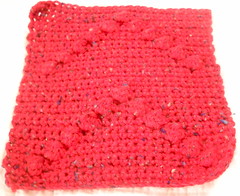
This year, I'm meditating on the attributes of the Divine by crocheting a 6"x6" square for each week of the Omer; each square will correspond to one sefirot via color.


It's now the 4th week of the Omer, so I'm going to play catch up over the next few days. The first week of the Omer corresponded to the sefirah of Hesed (Lovingkindness). Hesed represents the generous, benevolent side of God, the quality of unconditional Divine Love. Hesed is often translated in this context as "love," "compassion," or "grace." Hesed is associated with the Divine name El or El Elyon (Supreme God). Hesed's color is white.


Here is my square for Hesed (Lovingkindness):
When my seven squares are complete, I will be mailing them to a Ravelry friend who will then forward them to For the Children of Pine Ridge. This group will piece them into warm blankets to be distributed at the Pine Ridge Reservation in South Dakota.